
Sea fishing equipment - fishing tactics - tips - location
Preparation
- Some T-Shirts is OK, but bring also some light-coloured sweaters and long pants. (protecting from the Sun & Mosquitoes)
- Make sure you have a good supply of sunscreen (30 +) and mosquitoes product (Example: Muskol)
- Providing beach sandals with a good sole
- Bring your "snorkeling" equipment
- Bring a rod tube or purchase multi-section travel rod
- Don't forget your camera
- Buy a (Spanish-English) dictionary (pocket format)
- Hat and polarized glasses (required)
Tips when you arrived
- Change your money at the airport — rates are usually better than at the hotel. Since 2021, Cuba no longer uses the CUC. The local currency is the Cuban Peso (CUP). Some establishments also accept euros or Canadian dollars directly.
- Book your rental car as soon as you arrive — vehicles go fast. Budget around 60–80 USD/day for a small car, depending on the season.
- Leave your passport and cash in the room safe; bring only the minimum you need in a waterproof zip-lock.
- Check with your airline or travel agent about current airport departure fees before you leave — this information changes regularly.
Fishing equipment & tackle
All your fishing tackle should be saltwater proof. (Otherwise they rust!)
- 1 rod (8-9 feet) for shore fishing / Cast weight 30 to 80 gr, for Tarpon, jack, Barracuda, snapper
- 1 rod (6-7 feet) Trolling & fishing from bridge (Heavy) for large Tarpon, Cubera, big fish
- 1 reel filled with 300+ yards of braided line 30-40 lb tests
- 1 reel filled with 300+ yards of braided line 50-80 lb tests
- Few steel leaders 15-20"/ 90 lb test or Nylon leader 130 lb tests
- Several saltwater lures (Float, Suspending, Popper, jigs)
- Storage box for lures
- Clear Mono 10 lb tests for bait fishing
- Clear Mono 60 to 80 lb to attach hooks
- stainless Hook size no #8/0,#5/0,#2/0,#2,#8,#14
- Swevel & Skinker of 3/4 to 1 ounces (Format: olive or bell)
- Hat, glove, polarized sun glasses, knife, multi-purpose pliers, headlamp (required)
- Foldable cooler, big zip-lock bag, backpack or hip bag for your tackle
- Line 20 to 50 feet long to hold the pedal or kayak (optional)
- Casting net 6 to 10 feet radius. (optional)


Browse all travel rods and sport fishing gear on PECHE SUD →
Best time for fishing in cuba
Fishing is generally good all year. You will always find common species like snapper, jack crevalle or barracuda throughout the year.
- Between November and February is the low season, water is colder, the fish tend to stay in deeper water and farther offshore. (Wahoo, Dorado)
- Between March and June is the peak season, tarpon, jacks and big "pargo snapper are there. (Tarpon, Trevally, Snapper, Tuna)
- Between July and August fishing is still very good, except it's hot. But it's the perfect for evening or night fishing trip, favored the week before full moon. (Perfect time for cubereta "Grey snapper")
- Between September and October, it's tropical storms season, if you decide to go, be there just after the storm, fishing is excellent. The reefs are broken, all the fish come near the shoreline looking for food.
Tactics
We currently use four main fishing tactics:
- Spinning fishing with natural bait (fish meat, shrimps, crabs, worms "Calandraka")
- Spinning fishing with artificial lures
- Trolling with artificial lures (10, 20, 30 ft)
- Slow pitch jigging or Speed jigging (but require a boat)
If we fish from the shore, we are looking particularly for bridges, rocky points, deep channels, where the current is strong. But if we are in a boat, shallow coral reefs with "poppers", channels mouth, pit (Possa), potatoes fields (big stones with the potato shape). Locate passages between the sea and mangroves, where the tide constantly disturb seabed. Search for sardines, watch birds, look around mangroves feet, search for the natural structures where small fish get cover. Live bait is good tactic, but keeping bait fish alive remains a challenge. You can use small piece of shrimp on a small hook #14 to catch them or use a "Sabiki" rigs. Once you get the live bait, you will need a 3/4 or 1 oz sinker with big hook #2/0 or #5/0 mounted on a metal leader or a strong nylon.
Artificial lures capture bigger fish, less discomfort, no shrimp, no smell in the fridge, it stays clean. However, if you want fish for "cubereta", "Mojarra", "Garfish" or other smaller fish, you will need some natural bait like minnow, shrimp, worms, squid ... In August, during Cubereta's season you can catch a hundred per day.
Slow Pitch Jigging — what you should know
Slow Pitch Jigging is a Japanese technique developed by Norihiro Sato that has completely changed offshore fishing. Unlike speed jigging, slow pitch uses a wider, flatter jig (150–300 g) worked with deliberate slow lifts and free-fall pauses. The jig flutters and rolls on the fall, perfectly imitating a wounded baitfish — and that's when most strikes happen.
Key differences from speed jigging:
- Rod: a dedicated slow pitch rod with a very specific flex and slow recovery, essential for correct jig action. Standard jigging rods do not work well for this technique.
- Reel: overhead (conventional) reels preferred — they give precise control of line tension on the fall.
- Line: PE 2.0 to PE 2.5 braided line, thin enough to reduce water drag and let the jig sink freely.
- Jig weight: 150–300 g depending on depth and current. Rule of thumb: 1 g per metre of depth, adjusted for current.
- Leader: fluorocarbon 40–60 lb, 2–3 metres.
Target species with slow pitch jigging include amberjack (sériole), yellowfin tuna, grouper, snapper, and kingfish. Playa del Carmen (Mexico) and Costa Rica are ideal destinations to try this technique. Get your slow pitch jigging gear at PECHE SUD.
Fishing location
You can almost fish everywhere, except on bridges.
Tips
- In evening buffet, prepare a "Lunch box", if you leave early for fishing.
- Take several bottles of water.
- Take some ice at the lobby bar, fill your cooler.
- Keep your bait in the cooler.
- If you keep some shrimps in your fridge, keep them in 2 or 3 layer of zip-lock bag, in the freezer section
Tackle maintenance
- Never leave your reel in saltwater or on the sand.
- Rinse your rods, reels and lures after each use with fresh water. They may be saltwater resistant, but it doesn't prevent the formation of salt crystals.
- Don't let your fishing gear dry on your balcony, leave them inside.
Some spanish words
Hello Buenos días or Ola
Please, i want... Por favor, querria...
Where is ? ¿Dónde es?
What time is ... A qué hora es...
High tide alta marea
Low tide Bajamar
Sea Mar
A little Un poco
Fishing Pescar
Fresh shrimp (raw) Camaron crudo
Fresh fish (raw) Pescado crudo
Fresh octopus (raw) Calamar crudo
Water Agua
Ice Hielo
Fishing rod Barra
Deep pit in the sea Fosa or Possa
Some basic knots
Three kind of knots to use- MirrOlure knot for tying directly your lure to the leader (without swevel)
- Rapala knot, another good one
- Clinch (improved) knot, link the line to terminal tackle
- Orion knot, double universal knot, use to attach line to swevel


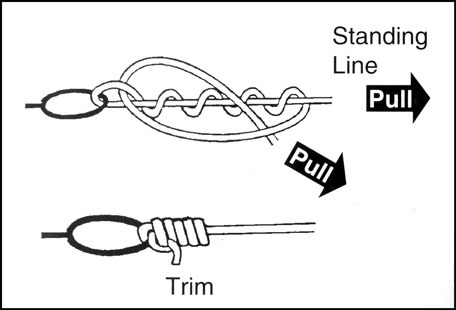

How to attach leader to braided line
It's the knot we use to attach leader to braided line for Jack popping. It's good for inshore fishing only.
How to avoid rod brakage
This small video will help you to understand how to hold the fishing rod correctly and avoid rod tip breakage
My fish lexical
Fish names and photos in english, french, spanish (es)pagnol or Cu(ba)


Fishing in Cuba - General Section
